Neither an Art Book or Book on Artã¢ââ¦the Artists Book Is a Work of Art on Its Own
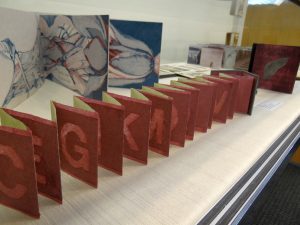 "Some books are to be tasted, others to be swallowed, and some are to be
chewed and digested."
~Francis Salary, Essays (1625) Salary'south Essays By Francis Bacon, Richard Whately.
We have talked about artists' books on the Smithsonian Libraries blog before. And we'll talk about them more, equally a part of a short series to highlight interesting works of volume fine art endemic by the Smithsonian's American Art & Portrait Gallery Library.
Merely what, exactly, is an artist'south book? You may non be able to tell merely from looking at the object itself!
The uncomplicated answer to someone not familiar with artists' books might be: fine art in book form. But they are non quite so simple…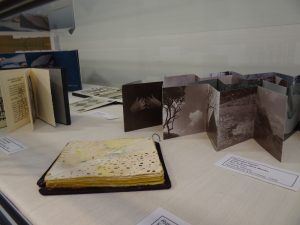
An artist's book is a medium of creative expression that uses the form or function of "book" every bit inspiration. It is the creative initiative seen in the illustration, choice of materials, creation process, layout and design that makes it an fine art object. A book that only contains text is simply a book; even if authored by an creative person, information technology would be a book that belongs in a book store or the shelves of a library.
What truly makes an artist's book is the creative person's intent, and artists have used the book as inspiration in a myriad of means and techniques, from traditional to the experimental. The book could be made through fine press printing or hand-crafted, the pages illustrated with estimator-generated images or cheap photocopies; books became sculptures, tiny and gargantuan; books were sliced up and reconfigured, made from all kinds of materials with unconventional objects incorporated, in unique or limited editions, or produced in multiple copies. With all sorts of ideas behind them, artists continue to claiming the idea, content and structure of the traditional book.
A piffling history…
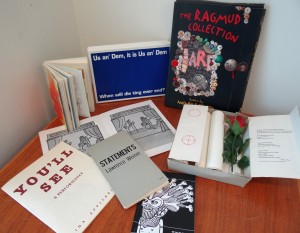 Although artists have illustrated the words of others in books since the advent of the printed book itself in the 1400s, the volume as art object is a product of the 20th century. In Europe from the 1950s, artists were experimenting with the book format, making books with unique printing and bindings, such as slits or holes cut through the pages and unique shapes for the binding or boxing. In the United states of america, Ed Ruscha produced some of the first artists' books consisting of compilations of photographs with a title on the front end cover and little narrative quality. Other artists used the book format to create narratives to bargain with hard or emotional bug, and some used information technology as a inexpensive, portable fashion to brand the artwork available to a broader public than the gallery and museum earth allowed.
Fast forward to today, artists' books exist at the intersections of printmaking, photography, poetry, experimental narrative, visual arts, graphic design, and publishing. Artists' books have fabricated a place for themselves in the collections of museums, libraries and bibliophiles, they accept caught the interest of fine art historians and critics writing virtually fine art, and there are numerous studio programs in art schools dedicated to the fine art of the book, ushering in new generations of artists making books.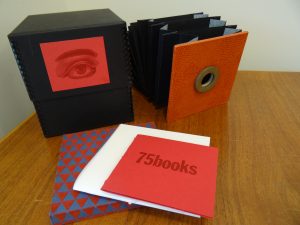
There are a few complications with artists' books. Compared with other 20th century art movements and media, such as Conceptualism or sculpture, there are few scholarly texts dedicated to the medium, and the existing scholarship does not always concord! Fifty-fifty how to properly punctuate the term is disputed: whether "artist's volume," "artists volume" or "artist book." Not to mention the question of where they physically vest—in museums or in libraries? Books are meant to exist touched, and their pages turned, just an art object is commonly only experienced under glass in a museum. These are issues that affect the piece of work of artists, practitioners of volume arts, curators, museum collections staff, librarians, publishers and others.
Yet the problems of the ambivalent nature of the artist's book is part of what gives it such interesting potential.
And stay tuned for upcoming posts on artists' books in the collection of the Smithsonian AA/PG Library!
For more general information on artists' books, delight see:
The Periodical of Artists' Books
The Bonefolder: an e-journal for the bookbinder and book creative person.
Printed Matter: non-turn a profit system dedicated to the promotion of publications made past artists.
Artists' Books: a critical anthology and sourcebook. ed. Joan Lyons. Rochester: The Visual Studies Workshop Printing, 1985.
Bury, Stephen. Artists' Books: the Book as a Work of Art, 1963-1995. Aldershot: Scolar Press, 1995.
Castleman, Riva. A Century of Artists Books. New York: Museum of Modern Art, 1994.
Drucker, Johanna. The Century of Artists' Books. 2nd ed. New York City: Granary Books, 2004.
Artist/Author: Contemporary Artists' Books. Eds. Cornelia Lauf and Clive Phillpot. New York: Fine art Publishers Inc., 1998.
Perrée, Rob. Cover to cover: the creative person's book in perspective. Rotterdam : NAi Publishers, 2002.
Source: https://blog.library.si.edu/blog/2012/06/01/what-is-an-artists-book/
0 Response to "Neither an Art Book or Book on Artã¢ââ¦the Artists Book Is a Work of Art on Its Own"
ارسال یک نظر