What Happens to Water in the Atmosphere as It Rises
All of the water on Earth makes up the hydrosphere. And that water doesn't stay nonetheless. It is ever on the move. Rain falling today may have been water in a distant sea days before. And the water you run across in a river or stream may have been snow on a loftier mountaintop. H2o is in the atmosphere, on the state, in the sea, and undercover. It moves from place to identify through the water cycle .
Where's the h2o?
There are about i.4 billion km3 of water (336 million mi3 of h2o) on Earth. That includes liquid h2o in the ocean, lakes, and rivers. It includes frozen water in snow, ice, and glaciers, and h2o that'southward underground in soils and rocks. It includes the h2o that's in the atmosphere as clouds and vapor.
If you could put all that water together – like a gigantic water drop – it would be 1,500 kilometers (930 miles) beyond.
Of all the h2o in the hydrosphere, the vast majority, about 97% of it, fills the bounding main. Nigh 2% of the water on Earth is frozen in ice sheets well-nigh the poles and in glaciers. Sometimes the water ice on Earth is included in the hydrosphere and sometimes information technology's seperated into a special part of the Globe system called the cryosphere. Near of the ice is in Antarctica, a smaller amount in Greenland in the Arctic, and a tiny fraction in mountain glaciers effectually the earth. Nigh of the remaining 1% of Earth'south water is underground, in shallow aquifers, as soil moisture, or deep underground in rock layers. Just a small fraction of the water on Earth (0.03%) is in lakes, wetlands, and rivers.
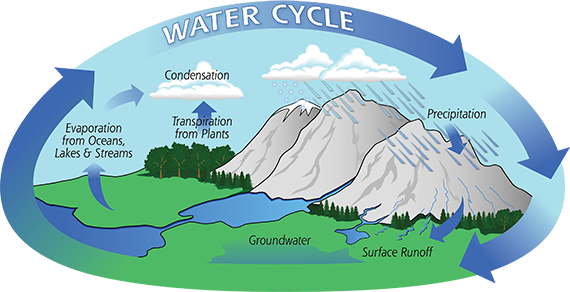
The main processes in the water bicycle
Credit: NASA
Water's on the move.
As it moves through the h2o cycle, h2o often changes from a liquid, to a solid (water ice), to a gas (water vapor). Water in oceans and lakes is typically liquid; but it is solid ice in glaciers, and frequently invisible water vapor in the atmosphere. Clouds are tiny aerosol of liquid water or small ice crystals.
H2o at the surface of the ocean, rivers, and lakes can go water vapor and move into the atmosphere with a little added energy from the Sun through a process chosen evaporation. Snow and water ice tin also plough into water vapor, which is a process known every bit sublimation. And water vapor gets into the atmosphere from plants, also, which is chosen transpiration.
Considering air is cooler at higher altitude in the troposphere, water vapor cools every bit it rises high in the atmosphere and transforms into water droplets past a process chosen condensation. The water droplets that class make up clouds. Water vapor tin also condense into droplets most the ground, forming fog when the ground is cold. If the temperature is cold enough, ice crystals course instead of liquid h2o droplets.
If the droplets or ice crystals within clouds grow in size, they eventually become also heavy to stay in the air, falling to the basis equally pelting, snow, and other types of precipitation.
What happens to the rain and snow that autumn?
Around the world, each year, most 505,000 kmthree (121,000 miiii) of water falls as rain, snow, and other types of precipitation.
86% of those raindrops and snowflakes come from the ocean where 434,000 km3(104,000 mi3) of water evaporates into the atmosphere each yr. Water somewhen returns to the ocean as precipitation that falls directly into the sea and equally precipitation that falls on land and flows to the bounding main through rivers.
Less h2o evaporates over the country than falls onto country equally precipitation. Evaporation of water from the country happens directly from lakes, puddles, and other surface h2o. Also, water too makes its style into the atmosphere via a process called transpiration in which plants release water into the air from their leaves that was pulled up from the soil through roots. Collectively, the h2o evaporated from the state and from plants is called evapotranspiration.
Some of the snow and ice that falls as atmospheric precipitation stays on the country as a part of icy mountaintop glaciers or the water ice sheets that comprehend places like Greenland and Antarctica. Some of the atmospheric precipitation seeps into the ground and joins the groundwater that is oftentimes tapped by wells to provide water to farms, towns, and cities.
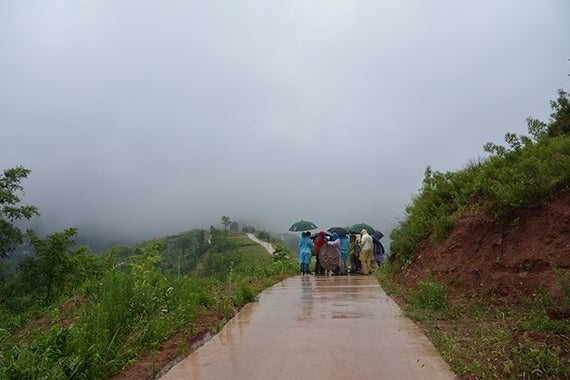
A rainy solar day in the countryside near Xi'an, Mainland china
Credit: L.S. Gardiner
How long does water stay in a place before information technology moves?
The length of time that detail water molecules stay in a part of the water cycle is quite variable, merely water does stay in certain places longer than others.
A driblet of h2o may spend over iii,000 years in the ocean before evaporating into the air, while a drop of water spends an average of just ix days in the atmosphere before falling dorsum to Earth.
Water spends thousands to hundreds of thousands of years in the large ice sheets that cover Antarctica and Greenland. The oldest ice in Antarctica has been at that place for ii.7 meg years. However, snowfall that falls in the wintertime may only stick around for a few days in mid-latitudes locations, where temperatures often rise above freezing causing the snow to melt, or up to 6 months closer to the Arctic, where temperatures stay below freezing all winter.
H2o stays in soil for around 1 to two months although this varies greatly. H2o that's in soil moves into the atmosphere by evaporation and also past transpiration.
There are exceptions. For example, while h2o vapor spends relatively little time in the atmosphere, vapor that makes its way into the stratosphere, the layer of the temper above the troposphere where weather typically forms, may remain there for a long time. Also, while h2o by and large spends thousands of years in the bounding main earlier moving on, water in warm, shallow coastal areas may evaporate and leave the body of water very quickly every bit compared with other areas of the ocean.
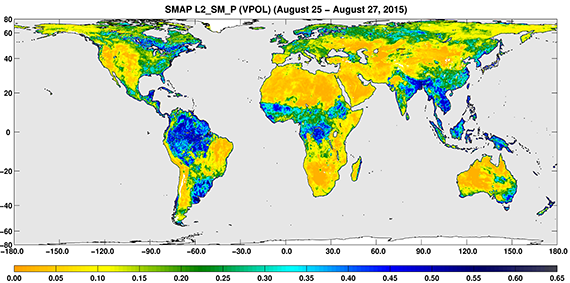
Soil moisture is typically higher at tropical latitudes than elsewhere. This three-day composite global map of surface soil moisture was fabricated with data from the NASA SMAP radiometer instrument between Aug. 25-27, 2015. Moist soils are shown in blue. The near dry out soils are shown in yellow and orangish.
Credit: NASA
Climatic change is affecting the h2o bike.
Warming global temperatures increases the rate of evaporation and precipitation. The impacts are expected to increment over this century as climate warms. Some areas may experience heavier than normal atmospheric precipitation, and other areas may become prone to droughts. Other parts of the h2o cycle - such as clouds, the ocean, glaciers and sea water ice - are as well afflicted by climate modify.
- Learn more: The Water Bike and Climate Change
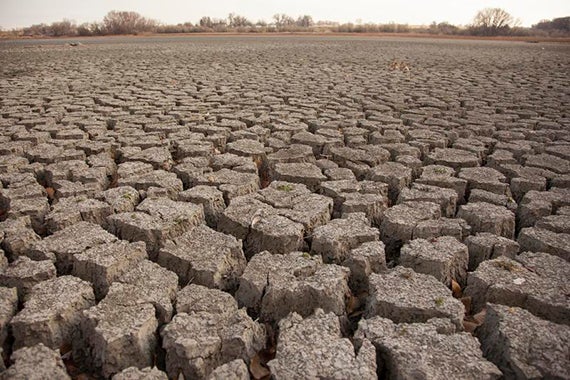
Mudcracks form during droughts when the footing dries out and moisture evaporates. As climate continues to alter, some areas are becoming more drought prone.
Credit: NOAA
Source: https://scied.ucar.edu/learning-zone/how-weather-works/water-cycle
0 Response to "What Happens to Water in the Atmosphere as It Rises"
ارسال یک نظر